







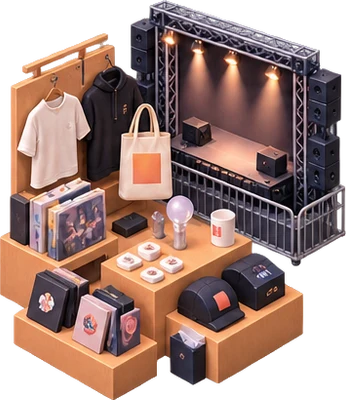

Merchandise and performances
When expanding IP into merchandise and live experiences, distinguish gross sales, revenue, and profit.
Why it matters
Analytically, direct merchandise sales can create inventory, return, and delivery burdens, while licensing has a different recovery structure. Performance economics also require subtracting venue, production, and operating costs from gross ticket sales. Comparing revenue sizes across different accounting and business structures alone can misrepresent roles.
Related companies
Webtoon and web-novel platforms and IP Adaptations, distinguishing creator-contract rights and exclusivity periods from gross versus net revenue recognition
An example connecting albums and performances to merchandise, licensing, and derivative IP. Based on 2023 SM 3.0 strategy materials, without treating planned figures as current results
Examples of roles spanning broadcasting, film, music, performances, IP merchandising, and overseas distribution
Album and digital-music distribution and artist-IP-based merchandise. Distribution does not mean ownership of all underlying IP
Explanation
CJ ENM describes expanding IP into merchandise, musicals, exhibitions, and games; YG PLUS introduces artist-IP-based merchandise. WEBTOON filings distinguish gross and net revenue recognition for direct sales and intermediary transactions. Total merchandise sales therefore do not all become the IP owner’s or platform’s revenue.
Industry perspective
Indicators to watch
- Is the return from direct sales, licensing consideration, or intermediary fees?
- Who bears inventory, returns, delivery, and performance-cancellation risks?
- Were gross sales distinguished from company revenue and profit?
Sources
- 2025 Form 10-K: IP rights, IP Adaptations, and revenue recognition ↗WEBTOON Entertainment · Checked 2026-10-10
- SM 3.0 IP Monetization Strategy (2023 strategy and outlook materials) ↗SM Entertainment · Checked 2026-10-10
- Music Solutions: album and digital-music distribution ↗YG PLUS · Checked 2026-10-10
- Company: artist-IP-based music and merchandise businesses ↗YG PLUS · Checked 2026-10-10
- TV Shows: broadcast content and overseas distribution ↗CJ ENM · Checked 2026-10-10
- Film: film production and distribution ↗CJ ENM · Checked 2026-10-10
- Music: artists, music, performances, and distribution ↗CJ ENM · Checked 2026-10-10
- Contents Business: expanding IP into merchandise, musicals, exhibitions, and games ↗CJ ENM · Checked 2026-10-10
- Performing Arts: performance business ↗CJ ENM · Checked 2026-10-10