Will oil prices stay high even when exports return?
A fictional story exploring another perspective
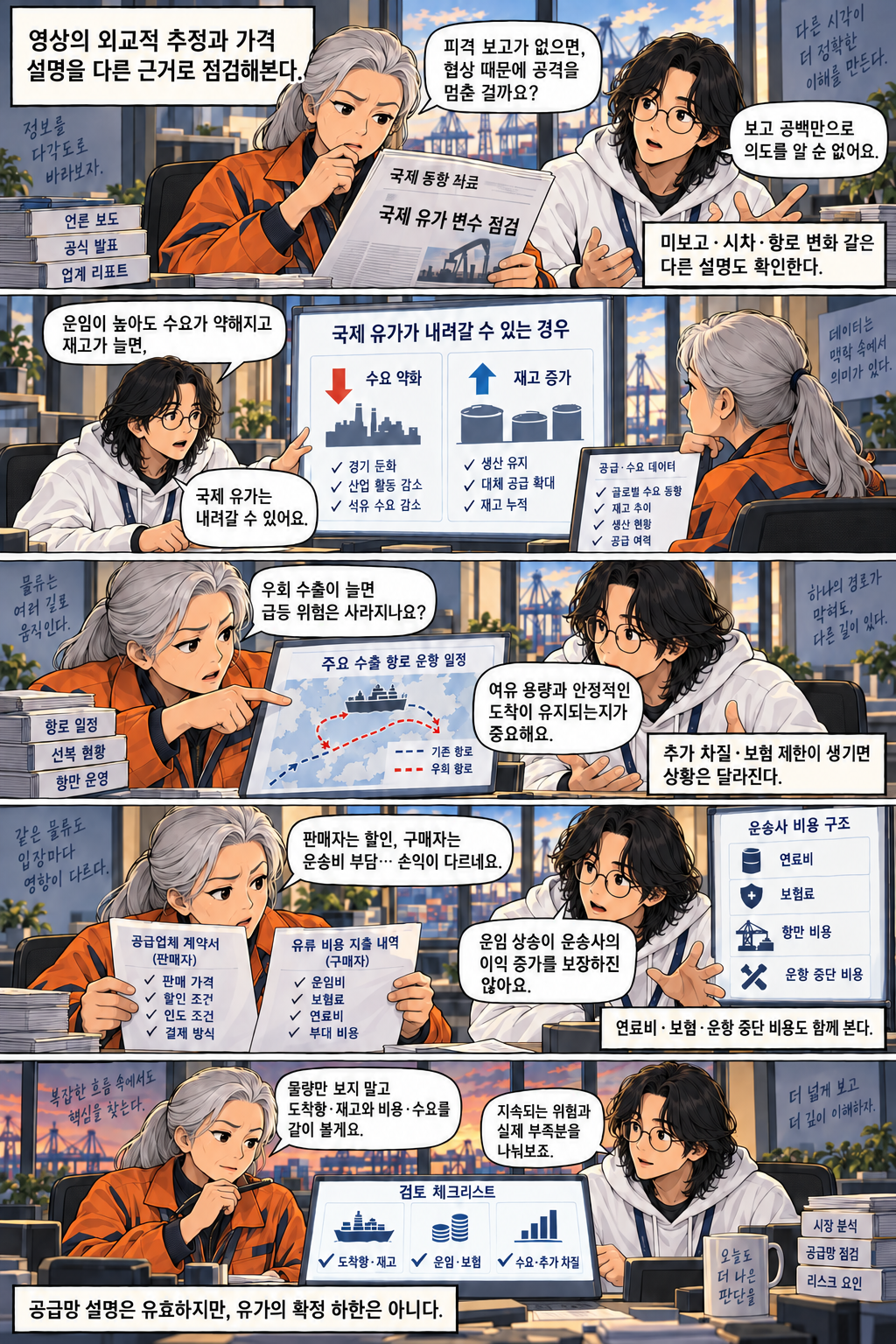
Distinguish transport risk from international oil prices, and consider conditions that change with demand and inventories.
Dialogue
Exports recovered, so why aren’t oil prices falling?
The video points to transport costs and attack risks.
That matters. But does it explain the whole price?
Do international oil prices rise by the same amount as freight costs?
Our landed cost and the international benchmark price differ.
Who pays the extra cost depends on contracts and alternative supply.
If producers discount, the burden gets shared.
Cargo leaving a port and cargo arriving on time differ too.
Export recovery alone does not establish a normalized supply chain.
Dialogue
If there are no attack reports, did negotiations cause attacks to stop?
Absent reports alone do not reveal intent.
Check alternatives such as non-reporting, reporting delays, or changed routes.
Even with expensive freight, weaker demand and rising inventories can lower international oil prices.
If diverted exports rise, does the risk of a surge disappear?
Spare capacity and consistently reliable arrivals matter.
Additional disruption or insurance restrictions change the situation.
Discounts for sellers, freight burdens for buyers… different financial outcomes.
Higher freight rates do not guarantee higher carrier profits.
Check fuel, insurance, and interrupted-operation costs together.
I will examine arrivals, inventories, costs, and demand—not just volumes.
Separate persistent risks from actual shortages.
The supply-chain explanation is valid, but not a certain floor under oil prices.
ASSETCASTING commentary
An interpretation of the fictional story, not a statement by the original video creator.
The export-recovery and transport-cost explanation at 4–200 seconds is expressed in original dialogue, then cost sharing and price differences are examined. The original video also explains that additional costs do not all pass through to international oil prices, so this is not claimed as an omission. Current oil prices, transshipment costs, and export volumes are not reproduced without independent verification. EIA explanations of price factors and independent procurement and logistics analysis are used; fictional characters and contract materials do not depict actual events or trades.
At 200–347 seconds, the original video presents a possible connection between diplomatic timing and absent reports, while acknowledging coincidence. The webtoon does not establish it as fact and adds alternatives. UKMTO material is used to establish the nature of reporting products, not to verify particular attack dates, perpetrators, or negotiation intentions from the video. The assessment of possible surges and export drops at 347–460 seconds is reconsidered through spare capacity and reliable arrivals. Weaker demand, inventory growth, and shipping disruption are independent conditional scenarios—not actual observations, a certain price floor, or trading advice.