Arctic routes: shorter distance is not cheaper transport
Compare conventional and Arctic routes over real coastlines for ports in Korea, China and the United States, including potential shortcuts and constraints from costs and seasonality.
Select a point to explore the industrial flow, bottlenecks and related companies.
How to read this map
Country comparisons connect key waypoints over real coastlines as educational scenarios. They are not current scheduled services or measured vessel tracks. We distinguish the Northeast Passage along Russia's coast from the Northwest Passage through the Canadian archipelago. The industry diagram below connects cargo, ice, vessels, services and regulation to transport economics.
How shipping routes change by country
Compare conventional and Arctic alternatives between the same ports. US West and East Coast conditions differ.
Natural Earth coastlines · illustrative waypoints · not for navigation. This does not indicate an open route or a scheduled service.
Potential benefits
Cargo bound for Northern Europe could avoid part of the southern detour through Suez. Voyage-time savings depend on vessel speed and ice conditions.
Potential demand for Korean ice-capable vessels, propulsion and maintenance, and Busan's role as a support hub, can be assessed. Potential demand does not guarantee new orders or profits.
Conditions and limitations
Icebreaking, insurance and vessel premiums, cargo capacity and port-call differences mean that shorter distance does not translate directly into lower freight rates.
Operating along Russia's coast requires checking authority permissions and sanctions for each counterparty, cargo and service.
This does not imply year-round access or a current scheduled service. Ice, vessel class, insurance, rescue capability and the port network must be checked for each voyage.
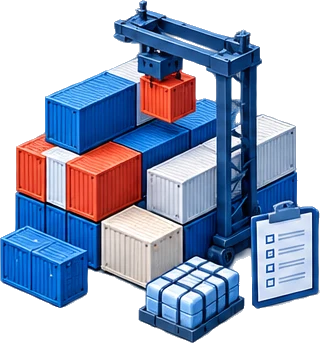
Cargo and transport economics → Sea ice, weather, and operating windows · Compare cargo deadlines and seasons with operating windows
Sea ice, weather, and operating windows → Ice-capable vessels and propulsion · Operating conditions determine required vessel specifications
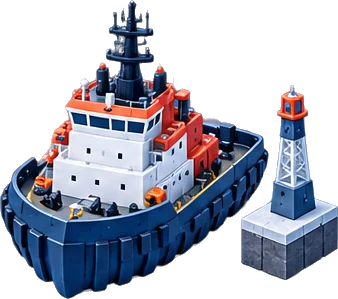
Ice-capable vessels and propulsion → Icebreaking support, ports, and communications · Support and recovery plans appropriate to vessel capabilities
Icebreaking support, ports, and communications → Schedules and liner reliability · Support waiting times and transshipment affect schedules
Sea ice, weather, and operating windows → Schedules and liner reliability · Changing sea ice and weather constrain schedules
Rules, permits, and sanctions → Ice-capable vessels and propulsion · Transaction conditions for vessel/equipment procurement and maintenance
Rules, permits, and sanctions → Icebreaking support, ports, and communications · Review rules for support, transshipment, and settlement
Rules, permits, and sanctions → Insurance, rescue, and environmental risks · Review rules and sanctions affecting insurance services
Insurance, rescue, and environmental risks → Schedules and liner reliability · Recovery and service continuity after accidents or breakdowns
Schedules and liner reliability → Cargo and transport economics · Reincorporate delay, inventory, and connection costs into financial outcomes
Cargo and transport economics → Shipbuilding, equipment, and port effects · Sustainable demand supports orders
Rules, permits, and sanctions → Shipbuilding, equipment, and port effects · Institutional conditions for orders and payment collection
Shipbuilding, equipment, and port effects → Ice-capable vessels and propulsion · Examples of design, propulsion, and construction capabilities
Map limitations
An industry-learning map, not a tool for navigation, insurance underwriting, or legal decisions. Actual voyages require current charts, sea-ice and weather information, vessel-specific operating limits, official permits, and expert review. Sanctions and environmental rules can change; the date sources were checked does not certify every transaction as lawful. Companies illustrate roles through public technologies and services. Korean companies’ capabilities and potential demand must be distinguished from specific new orders, revenue recognition, or share-price gains. Industry perspectives and watch points are analytical interpretations linked to evidence, not forecasts guaranteeing returns, scheduled voyages, or year-round use.
Educational industry diagram, not a reproduction of actual layouts, geography or operating routes.
Technology
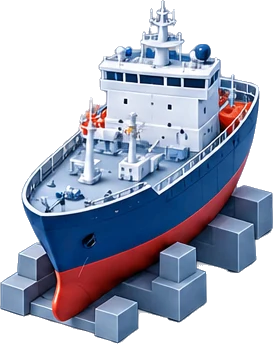
Ice-capable vessels and propulsion
Ice-resistant hulls and propulsion are needed, but higher specifications do not always lower transport costs.
Why it matters
Analytical interpretation: specialized vessels reduce risk while also creating investment costs and operating constraints. Considering open-water efficiency, maintenance, and annual utilization alongside icebreaking capability distinguishes technical strengths from economics.
Related companies
Samsung Heavy Industries
Public technology examples of icebreaking LNG carriers and Arctic shuttle tankers—not evidence of a particular new project order
Hanwha Ocean
Public construction examples of icebreaking LNG carriers for Arctic operation. Past deliveries and potential new orders are separate
ABB
Ice-capable Azipod electric propulsion—not a guarantee of independent operation on every route
Aker Arctic
Ice-capable vessel design and ice-basin model testing: an example of design-performance validation
DNV
Classification, technical review, and risk-analysis services for polar and low-temperature operations
Explanation
Ice imposes additional loads on hulls and propulsion. ABB publishes ice-capable Azipod electric propulsion, Aker Arctic publishes ice-capable vessel design and ice-basin testing, and Samsung Heavy Industries and Hanwha Ocean publish icebreaking LNG technologies and construction examples. These illustrate technical roles, not that any vessel can pass through all ice conditions. Polar Code operating-condition assessments and classification ice rules must also be checked.
Industry perspective
Indicators to watch
What ice and low-temperature conditions underpin design and testing?
Were vessel capabilities distinguished from permitted operating conditions?
Were off-season use and maintenance systems compared too?