

Dialogue
If GPU Futures Are Approved, Will Memory Stocks Rise Too? Assumption: Review passes by 2026-11-09 · Trading starts afterward As of 2026-10-16, approval and launch remain unconfirmed Fictional characters and dialogue · Not statements by actual company or exchange representatives. If approval news appears Harin: GPU futures got approved? That must be good for AI stocks, Samsung Electronics and SK hynix! Jiwoo: It could create optimism. But several steps separate approval from corporate earnings. This is not a contract to receive GPUs Harin: If I buy futures, do I receive GPUs later? Jiwoo: No. The planned product settles in cash based on a GPU rental-rate index. It is not an order for GPUs or HBM. Potential benefit for renters Harin: A sudden jump in rental rates squeezes our service margins. Jiwoo: If a hedge closely matches your actual costs, it could offset some cost-increase risk and make budgeting easier. Potential benefit for rental providers Minseok: If rental rates fall, it becomes harder for us to recover the cost of expensive GPUs. Jiwoo: Selling futures could offset some downside risk. More stable cash flow might also help with financing.

Dialogue
That does not mean a cost discount Harin: So AI operating costs fall just because futures exist? Minseok: Wait, don't erase that so quickly. We need to examine the cost structure more carefully. Jiwoo: Managing price fluctuations is different from lowering the costs themselves. Trading costs and cash requirements also exist. The real question is AI ROI Harin: Ultimately, money spent on AI needs to return as revenue or cost savings. Jiwoo: Exactly. That is the core of return on investment, or ROI. You need to consider development, labor and electricity costs as well as compute costs, alongside the actual benefits. Positive scenario: Usage increases further Harin: What if managing costs lets us run more profitable services? Minseok: GPU usage and utilization could increase. Jiwoo: If that increase is large enough and sustained, it could lead to additional server investment. Negative scenario: The business does not earn enough Harin: But what if users increase and we still do not earn enough? Jiwoo: Hedging cannot create a profitable business for you. If customers cut investment, GPU expansion and orders for related components could suffer too.
Dialogue
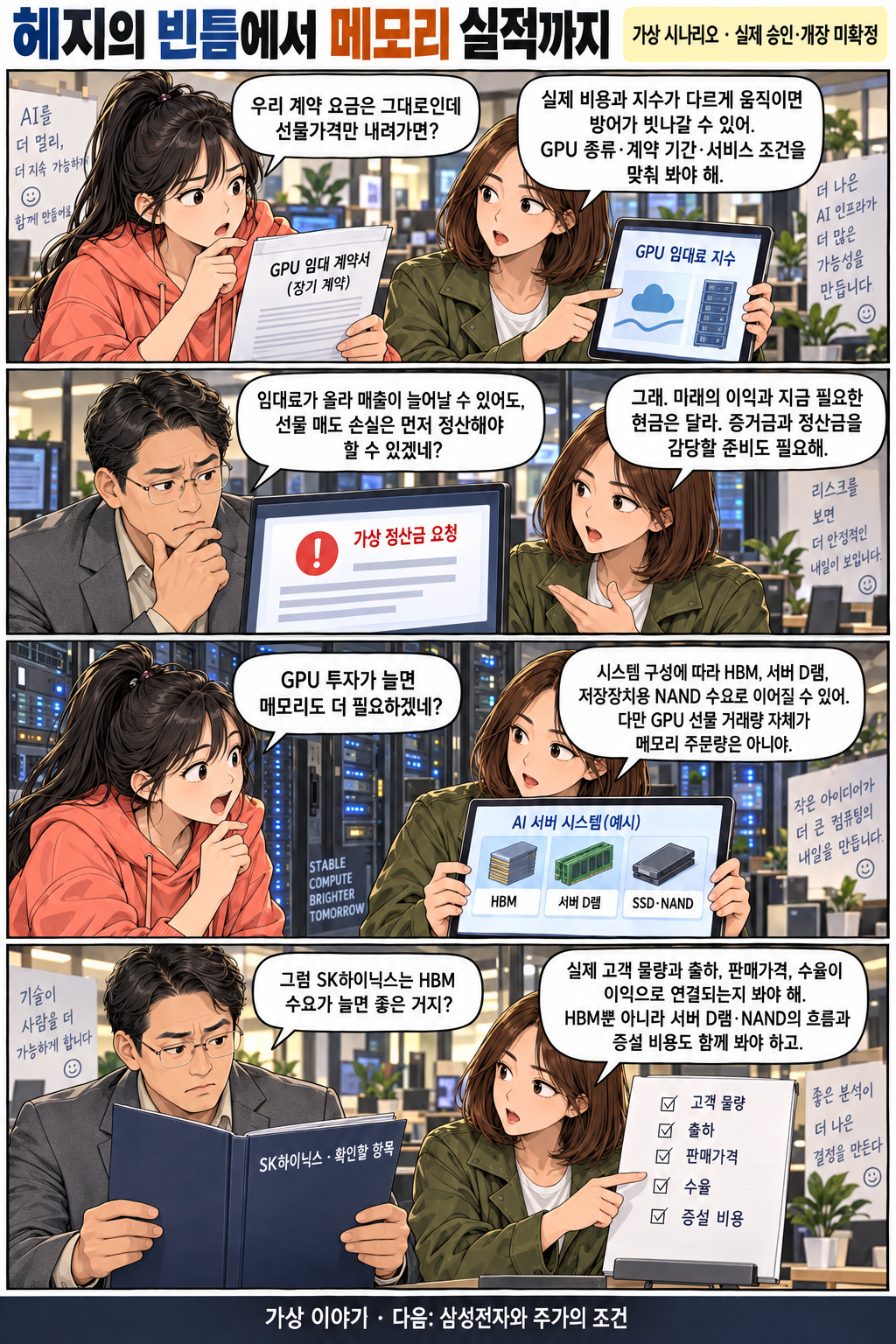
My contract and the index move differently Harin: What if our contracted rate stays the same while the futures price falls? Jiwoo: If actual costs and the index move differently, the protection can miss its target. You need to compare GPU types, contract periods and service terms. Hedging needs cash too Minseok: Even if higher rental rates could increase revenue, we might have to settle losses on a short futures position first? Jiwoo: Yes. Future profit is different from cash needed now. You also need to prepare for margin and settlement payments. This is where memory chips enter the picture Harin: If GPU investment grows, more memory would be needed too? Jiwoo: Depending on the system configuration, it could translate into demand for HBM, server DRAM and NAND for storage. But GPU futures trading volume itself is not memory order volume. What should we watch at SK hynix? Minseok: Then growing HBM demand is good for SK hynix, right? Jiwoo: Check whether actual customer volumes, shipments, selling prices and yields translate into profit. Watch server DRAM and NAND trends and expansion costs alongside HBM.

Dialogue
Does the same apply to Samsung Electronics? Harin: Would Samsung Electronics rise in the same way for the same reason? Jiwoo: Watch customer-specific HBM supply progress, shipments and profitability, and the DRAM and NAND product mix. Samsung Electronics is also affected by results in other businesses, such as foundry and smartphones. Falling rental rates can tell different stories Minseok: Are lower GPU rental rates bad for memory stocks? Jiwoo: Efficiency improvements could lower costs and greatly increase AI usage. Conversely, oversupply could reduce utilization and further investment. Harin: Even with the same price decline, we need to look at the cause and usage. Better earnings do not automatically mean higher shares Harin: If memory orders actually rise, share prices will rise too, right? Jiwoo: Prices might already anticipate even stronger growth. What matters is how earnings and cash flow, not just revenue, meet market expectations. What to check after approval Harin: I will check whether AI services actually make money. Minseok: I will watch GPU utilization, rental rates and the cash needed for hedging. Jiwoo: For Samsung Electronics and SK hynix, actual memory orders and profitability. And whether the futures market attracts enough trading to be genuinely useful. Approval of GPU futures could be a starting point for risk management. AI profitability, semiconductor companies' earnings and rising share prices are separate questions that each require verification.