Distinguish losses, IPOs, and usage metrics, and consider the evidence needed for claims of an AI collapse.
Dialogue
Do losses and a huge IPO mean a bubble about to burst?
They are risk signals, but they do not establish that conclusion.
An IPO’s company valuation and actual proceeds differ.
Separate money entering the company from existing shareholders’ sales.
Does preparing an IPO mean management is running away?
Check secondary share sales, use of proceeds, and lock-ups.
Pursuing an IPO alone does not prove an intention to exit at the peak.
Warning about risks while doing business does not make the warning false.
Whether safety measures are actually followed is a separate question.
Test both marketing possibilities and actual risks.
Do large losses mean the business model has failed?
First ask whether adding customers increases losses.
Subtract service-delivery costs from revenue, then examine retention and investment recovery.
Losses cannot be ignored, but their size alone does not reveal a collapse date.
Dialogue
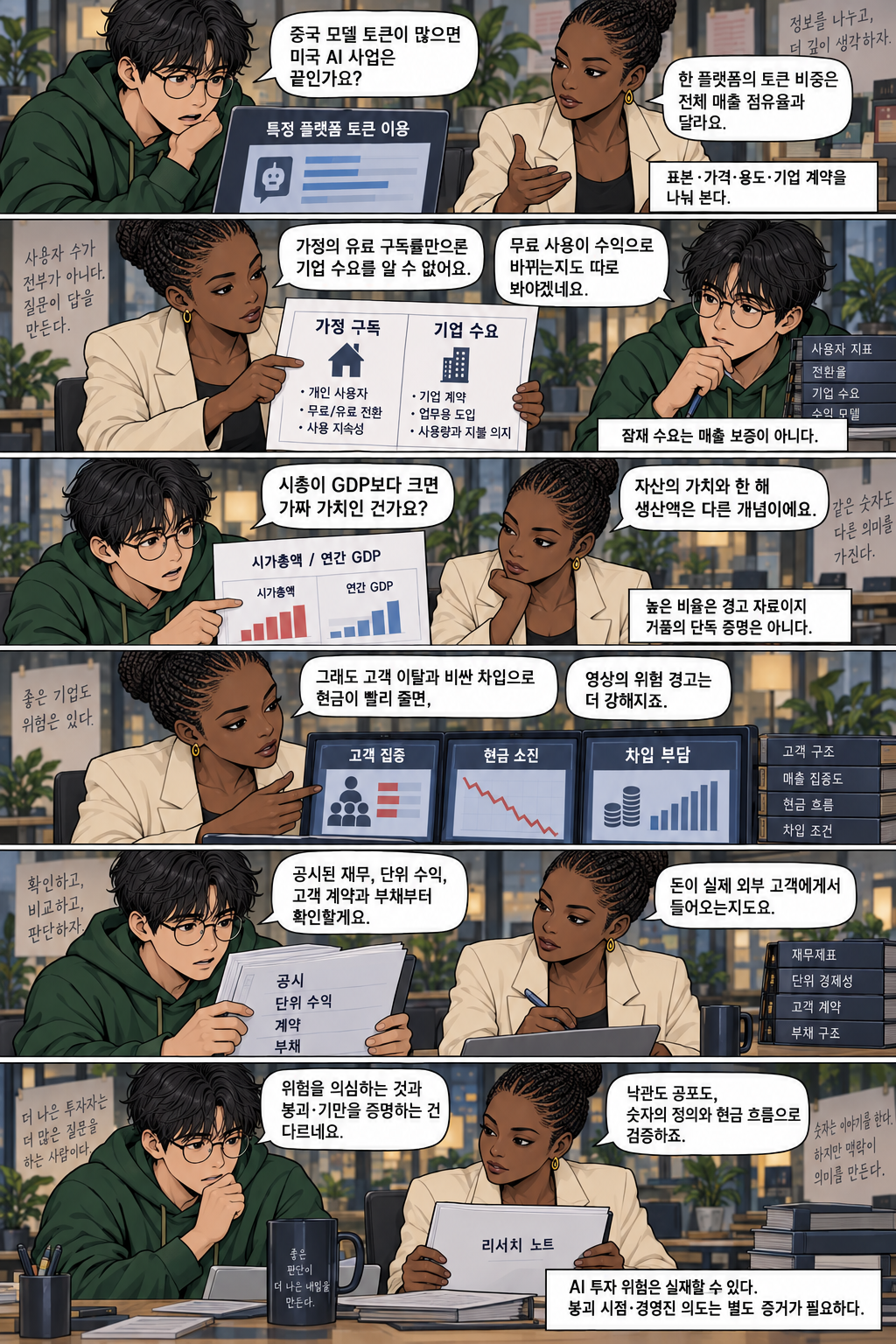
If Chinese models account for many tokens, is US AI business finished?
Token share on a single platform differs from total revenue share.
Distinguish the sample, prices, uses, and enterprise contracts.
Household paid-subscription rates alone do not reveal enterprise demand.
We should separately check whether free use converts into revenue.
Potential demand does not guarantee sales.
Does market capitalization exceeding GDP mean fake value?
Asset value and a year’s output are different concepts.
A high ratio is warning evidence, not standalone proof of a bubble.
Still, if customer departures and expensive borrowing rapidly drain cash, the video’s warning grows stronger.
I will check disclosed finances, unit economics, customer contracts, and debt first.
And whether money actually comes from outside customers.
Suspecting risk differs from proving collapse or deception.
Test optimism and fear through definitions of the figures and cash flows.
AI investment risks may be real. Collapse timing and management intent require separate evidence.
ASSETCASTING commentary
An interpretation of the fictional story, not a statement by the original video creator.
At 0–330 and 1507–1789 seconds, the video categorically connects IPOs and safety warnings to management’s cash-out motives; at 607–831 seconds, it relies on losses and demand. The webtoon does not determine whether those motives are genuine; it challenges conflating IPO structure with proof of intent. SEC materials offer a general basis for reviewing use of proceeds, selling shareholders, and lock-ups—not verification of any individual AI company’s IPO process, valuation, or proceeds. It distinguishes company value from offering size, and company proceeds from new shares from existing shareholders’ secondary sales. Its independent reasoning is that safety warnings and commercial activity coexisting do not establish whether warnings are true or false, or whether the technology is safe. Private finances, enormous IPO amounts, listing schedules, press quotations, government events, and remarks from the original video are not reproduced as facts without independent verification.
The primary counterarguments address platform-use and competition claims at 330–607 seconds, household-subscription metrics at 607–831 seconds, and market-capitalization/GDP interpretation at 1303–1507 seconds. OpenRouter materials are used only to check the sample and methodology of observations on that platform; this does not claim to verify current shares, superiority of Chinese models, or whole-industry revenue. BEA definitions explain GDP as a flow of output over a period, connected to independent analysis of market capitalization as asset value. A high market-capitalization/GDP ratio does not mean risk-free or fair value. Falsification conditions remain: worsening unit economics, customer departures, cash depletion, and borrowing burdens strengthen the warning. Potential enterprise demand, commercialization, and checking disclosures do not guarantee successful revenue, and political motives, company deception, or a crash date are not established. All graphs are original conceptual diagrams without actual figures.